A Beverage Bottling Line is a coordinated system that prepares containers, fills them with product, seals them, and readies them for shipment. Its exact layout depends on the drink, package, production speed, and factory space. A line handling glass bottles may need different equipment from one designed for lightweight plastic containers or cans.
In a typical setup, empty containers are fed into the line, rinsed or inspected where required, and moved to a filling machine. The filler measures or dispenses each portion, while a capper or seamer closes the package. Labels, date codes, and packaging equipment may follow. Sensors can flag missing caps, uneven fill levels, or containers out of position. Small details matter.
The process looks straightforward on a diagram. It isn’t always. Product thickness, foam, temperature, and container shape can affect filling speed and accuracy. A minor jam may slow several connected machines, not just one. Operators therefore monitor the equipment, check product and package quality, and follow the machine manufacturer’s operating and cleaning guidance. Still, no single line design fits every beverage or facility. This guide explains the main stages, how equipment works together, and what to consider when evaluating a bottling system.
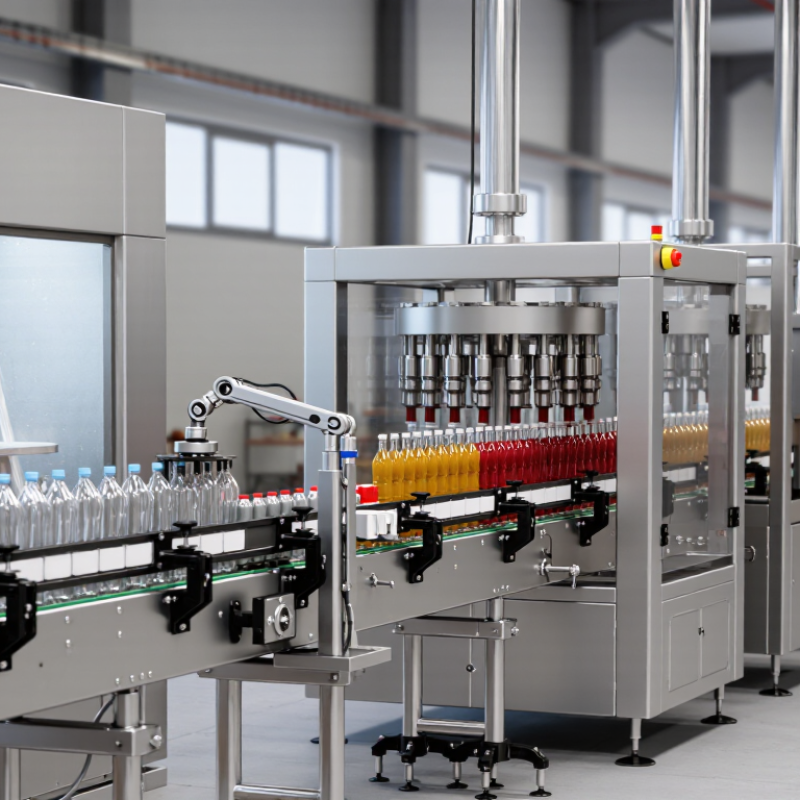
A beverage bottling line moves empty containers through six connected stages. The first stage is container handling: bottles are fed from a depalletizer or hopper and guided onto a conveyor. Next, rinsing or air cleaning removes loose dust before filling. Not every product needs the same treatment. At the filler, measured portions enter bottles through valves designed for the drink’s flow and foaming behavior. Operators watch fill levels and spills closely. Small details matter.
The fourth stage seals each container with a cap or other closure. A labeler then applies product information, while a coder marks details such as the production date and batch. Finally, case-packing equipment groups bottles into cartons or trays; a palletizer prepares cases for warehouse handling. Real lines are less tidy than diagrams: a crooked bottle or poorly formed case can interrupt several stages. PMMI’s 2023 State of the Industry report estimated U.S. packaging machinery shipments at $10.9 billion in 2022, reflecting the scale of equipment investment. That figure does not describe bottling lines alone, but it gives useful industry context. Regular checks of sensors, seals, fill accuracy, and conveyor transfers help teams catch small faults before they become costly stoppages.
A PET bottle often begins as a compact, thick-walled preform, not a miniature bottle. The preform’s threaded neck is already formed, while its body is reheated in a stretch-blow molding machine. Infrared lamps warm the PET evenly; the neck finish is kept cool to protect its dimensions. Then a stretch rod extends the softened preform inside a mold, and compressed air pushes it against the mold walls. The shape forms in seconds. Heat balance matters: a cold patch can leave a weak, cloudy area, while uneven stretching may create thin spots. Operators check bottle weight, neck roundness, and base shape—not just appearance.
Small details count. Molded bottles are inspected before filling, since a distorted neck can compromise the closure fit. NAPCOR’s 2023 report put the U.S. PET bottle recycling rate for 2022 at 29.1 percent. That figure gives bottlers another reason to consider material use and bottle design alongside line speed. Lightweighting can reduce resin use, but it needs careful validation; thin walls may deform during handling or filling. There is no universal setting. Preform design, resin behavior, and mold temperature all affect the result, and a line that runs well with one format may need adjustment for another.
After a PET preform is reheated, a stretch rod elongates it while compressed air expands it against the mold. Pre-blow starts shaping the bottle; high-pressure blow completes the shape and detail.
Illustrative operating settings: actual pressures vary with bottle design, material, and equipment.
A beverage bottling line links container handling, filling, capping, inspection, and packing. On a high-speed line, empty bottles pass through a rinser before star wheels guide them into the filler. Valves open in sequence, while flow meters or level probes help control each dose. Filled bottles move directly to a capper, where sorted closures are placed and tightened. Timing matters. At 60,000 bottles per hour, the line handles 1,000 bottles per minute, or about 17 each second. The filler and capper must stay synchronized. Sensors can flag missing caps, low fills, or tipped containers.
IBWA’s 2024 bottled-water statistics report about 15.9 billion gallons of U.S. bottled-water volume in 2023, with per-person consumption near 47.5 gallons. That scale helps explain demand for automated packaging, but not every plant needs maximum speed. Small losses matter. A five-minute stoppage at a rated 60,000 bottles per hour represents about 5,000 bottles of potential output. Actual production also depends on bottle size, foam, product viscosity, changeovers, and cleaning cycles. A published line rating is a peak figure, not a daily guarantee. I would check sustained output and cap-seal results during a real product run; speed alone can hide uneven fills.
A beverage bottling line moves containers through filling, capping, and inspection. Inline checks watch for drift while production continues. A level sensor can flag a low fill, while a reject gate diverts that bottle before packing. Operators should compare sensor readings with calibrated reference checks; a clean dashboard can still hide a poorly set sensor.
°Brix checks track dissolved solids through refractive index. ISO 2173:2003 defines the refractometric method for measuring soluble solids in fruit and vegetable products. A 10 °Brix reading represents roughly 10 grams of sucrose per 100 grams of sucrose solution. In juice or mixed drinks, it is a sucrose-equivalent reading, not a direct sugar test. Temperature and pulp can affect results. Small details matter.
Cap checks need the same care. Inline systems can monitor application torque, while removal-torque tests help verify closure performance. ASTM D2063/D2063M describes methods for measuring torque retention in threaded closures. There is no universal torque setting; the right range depends on the closure and container. Fill quantity also needs context: OIML R 87 gives a 3% tolerable deficiency for nominal quantities from 300 to 500 mL, as a reference framework. That is not a sensible production target. Set tighter operating limits, review trends, and investigate repeated rejects rather than simply resetting the line.
In a beverage bottling line, filled and capped containers move toward labeling and case packing. These stages may look routine, but they can affect product identity, traceability, and package condition. Under an ISO 22000:2018 food-safety management system, each step should connect with documented hazard controls and prerequisite programs.
A label check should confirm the correct product, ingredients, allergen information, and date or lot code. Operators can scan a sample at start-up and after a roll change, then record the result. Small details matter. A label from the previous run can confuse customers and weaken traceability.
Clear line clearance helps, though rushed changeovers can still leave one stray roll behind.
Case packing also needs practical controls. Keep cartons dry and intact, protect open product areas from dust, and check that bottles sit securely without cracked caps or leaks. Record batch links between bottles and cases, so affected stock can be identified if a concern arises.
These checks are only as reliable as their execution. A completed form does not prove that someone looked closely; periodic observation and review can reveal gaps the paperwork misses.
It is a compact, thick-walled starting shape. Its threaded neck is formed before the bottle body.
Infrared lamps warm the preform body while its neck stays cool. A stretch rod extends it inside a mold, and compressed air presses it against the mold walls.
Uneven heat can cause cloudy weak areas or thin spots. Small details matter.
They check bottle weight, neck roundness, and base shape. Not appearance alone. A distorted neck may prevent a reliable closure fit.
It can reduce resin use, but thinner walls may deform during handling or filling. Each bottle design needs careful testing.
Confirm the product, ingredients, allergen information, and date or lot code. Check samples at start-up and after changing a label roll.
Clear the line during changeovers and remove leftover rolls. A stray label roll can confuse customers and weaken traceability.
Keep cartons dry and intact. Check that bottles sit securely and have no cracked caps or leaks.
Batch links help teams identify affected stock if a concern arises. Record those links clearly.
No. Paperwork can fool us. Periodic observation and review may reveal gaps that records miss.
A Beverage Bottling Line brings together the equipment and controls used to move drinks from prepared containers into finished cases. The process typically includes six stages: container preparation, rinsing or cleaning, filling, capping, labeling, and case packing. For PET packaging, bottles may be stretch-blow molded from preforms before they enter the filling area. Coordinating these steps helps maintain a steady flow while protecting product quality.
High-speed filling and capping equipment can handle more than 60,000 bottles per hour, depending on the line and product. Inline checks can monitor fill levels, °Brix, and cap torque, helping operators identify variations during production. Labeling and case packing complete the process, while documented procedures and controls can support an ISO 22000:2018 food-safety system. Together, these stages turn prepared containers and beverage product into sealed, labeled packages ready for distribution.