Featured Industrial Liquid & Beverage Packaging Machinery
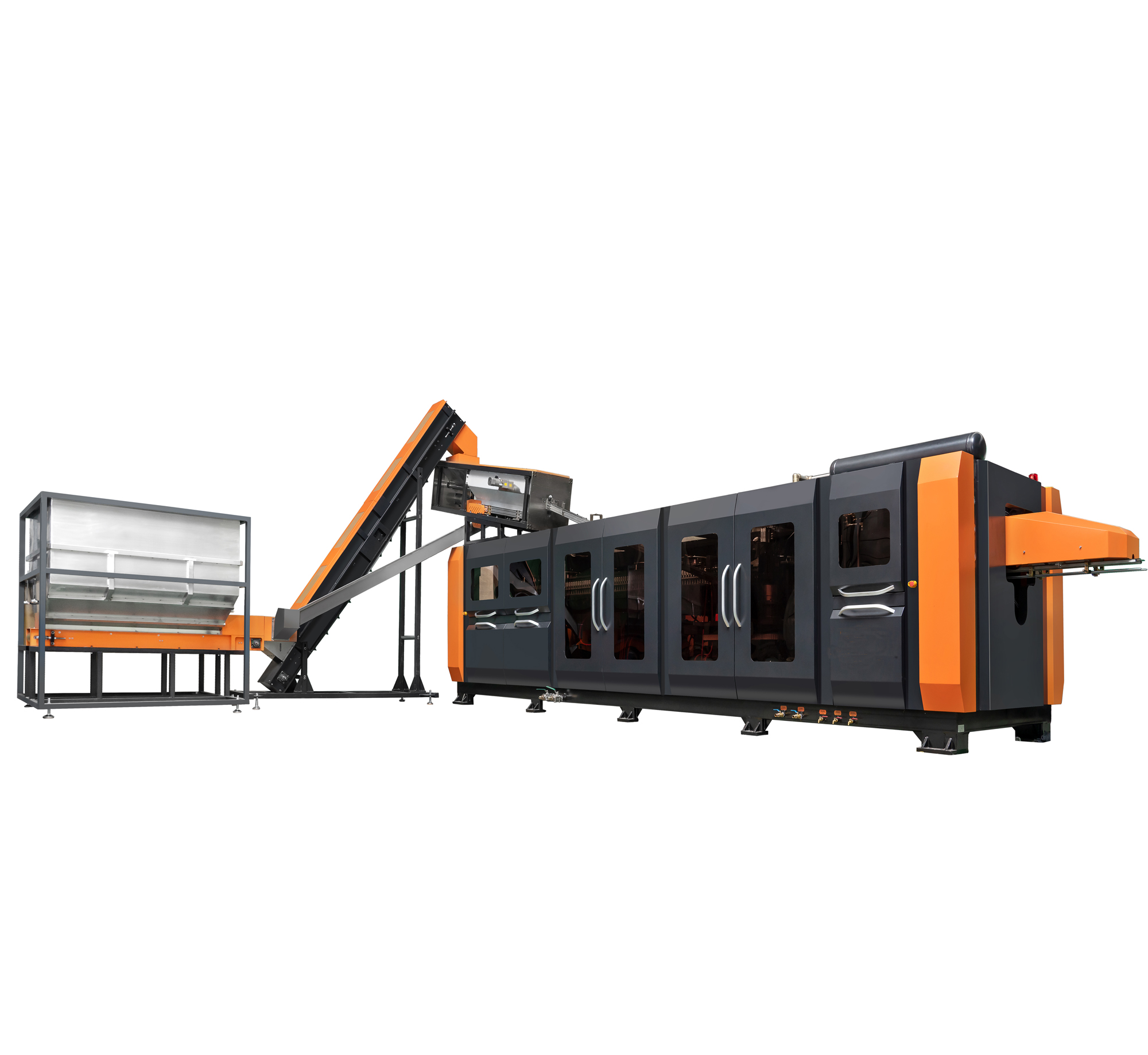
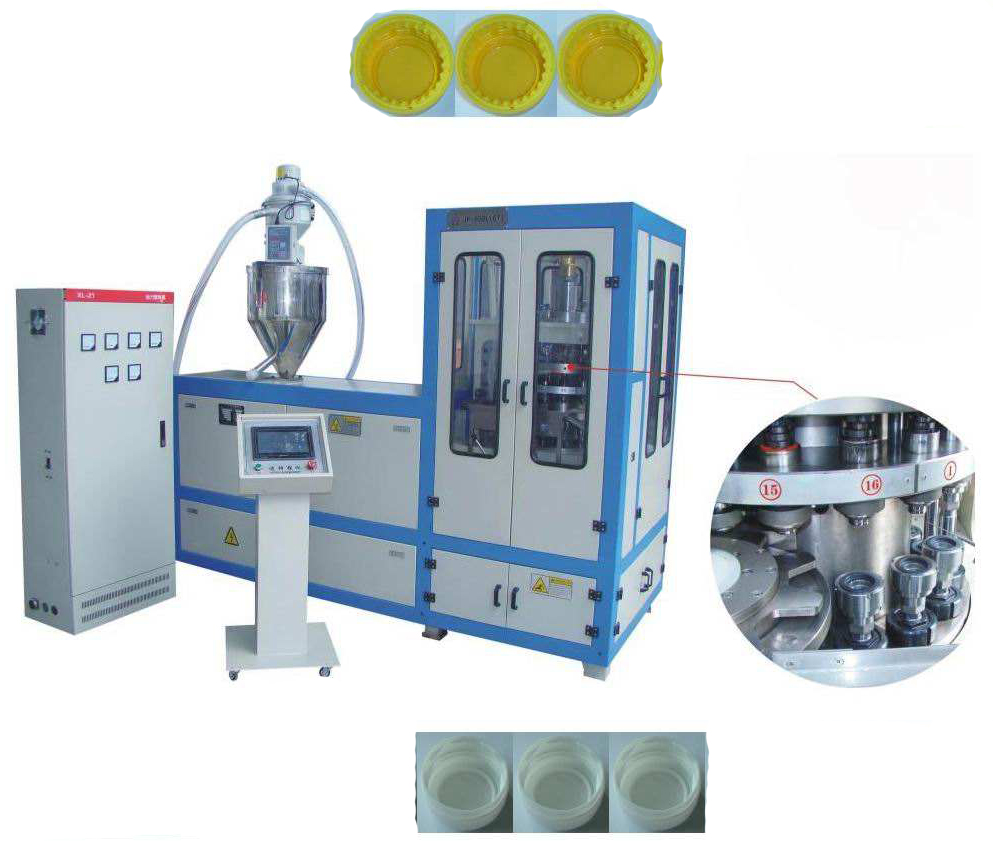
As a premier OEM manufacturer and global wholesaler, Lofsu Machinery delivers complete automated lines engineered to rigid European CE standards (Directive 2006/42/EC). Explore our foundational liquid treatment, container blowing, precision filling, inline sterilization, and sealing equipment built for seamless integration.

1. Executive Overview: Advanced Oenological Engineering & Bottling Line Integrity
In the contemporary global beverage market, bottling red, white, rose, and sparkling wines demands an unprecedented level of chemical stability, microbiological safety, and sensory protection. Unlike general beverage packaging (such as purified water or carbonated soft drinks), wine is a delicate, biochemically active matrix containing polyphenors, tannins, organic acids, and volatile aromatic esters. Exposure to ambient oxygen during transfers or turbulent filling rapidly induces irreversible oxidative degradation, browning, and loss of delicate bouquet.
As a world-class CE Certified Wine Bottling Line Supplier & Wholesaler, Lofsu Packing Machinery Co., Ltd. (established in 2010 in Zhangjiagang, Jiangsu, China) engineers high-precision, low-oxygen, sterile bottling architectures. Designed explicitly for commercial wineries, contract packaging facilities, and beverage distributors globally, our bottling lines harmonize mechanical speed with stringent oenological protection. Operating under full compliance with the European Machinery Directive 2006/42/EC and Pressure Equipment Directive (PED 2014/68/EU), Lofsu delivers turnkey solutions covering bottle rinsing, inert gas pre-evacuation, counter-pressure or low-vacuum filling, vacuum corking/capping, foil capsule shrinking, labeling, and automated end-of-line case packing.
2. Enterprise Manufacturing Advantage & Technical Authority
Selecting a wine bottling line supplier requires deep technical validation, structural traceability, and rigorous factory auditing. Lofsu Machinery combines over 15 years of liquid machinery specialization with an expansive 1,000–3,000 m² onsite-verified production facility in Zhangjiagang—China’s premier industrial hub for liquid packaging technology.
Rigorous CE & ISO 9001 Compliance
Every monoblock filler and downstream system features authentic CE certification. Electrical panels comply with EN 60204-1 safety standards, equipped with IP65/IP67 rated Omron or Siemens PLCs, Schneider contactors, and emergency stops.
Sanitary Metallurgy (SUS304 / SUS316L)
All wine contact surfaces are fabricated strictly from food-grade AISI 316L stainless steel with electro-polished internal surfaces ($Ra \le 0.4\ \mu m$) to prevent bio-film accumulation and enable complete CIP/SIP sterilization.
Global Custom Power & Field Support
We engineer control systems tailored to local electrical standards worldwide (220V–450V, 50/60Hz, 3-Phase). Lofsu provides remote video FAT testing, pre-shipment validation, and on-site overseas engineering deployment across 30+ nations.
3. Technical Engineering Architecture of Modern Wine Bottling Lines
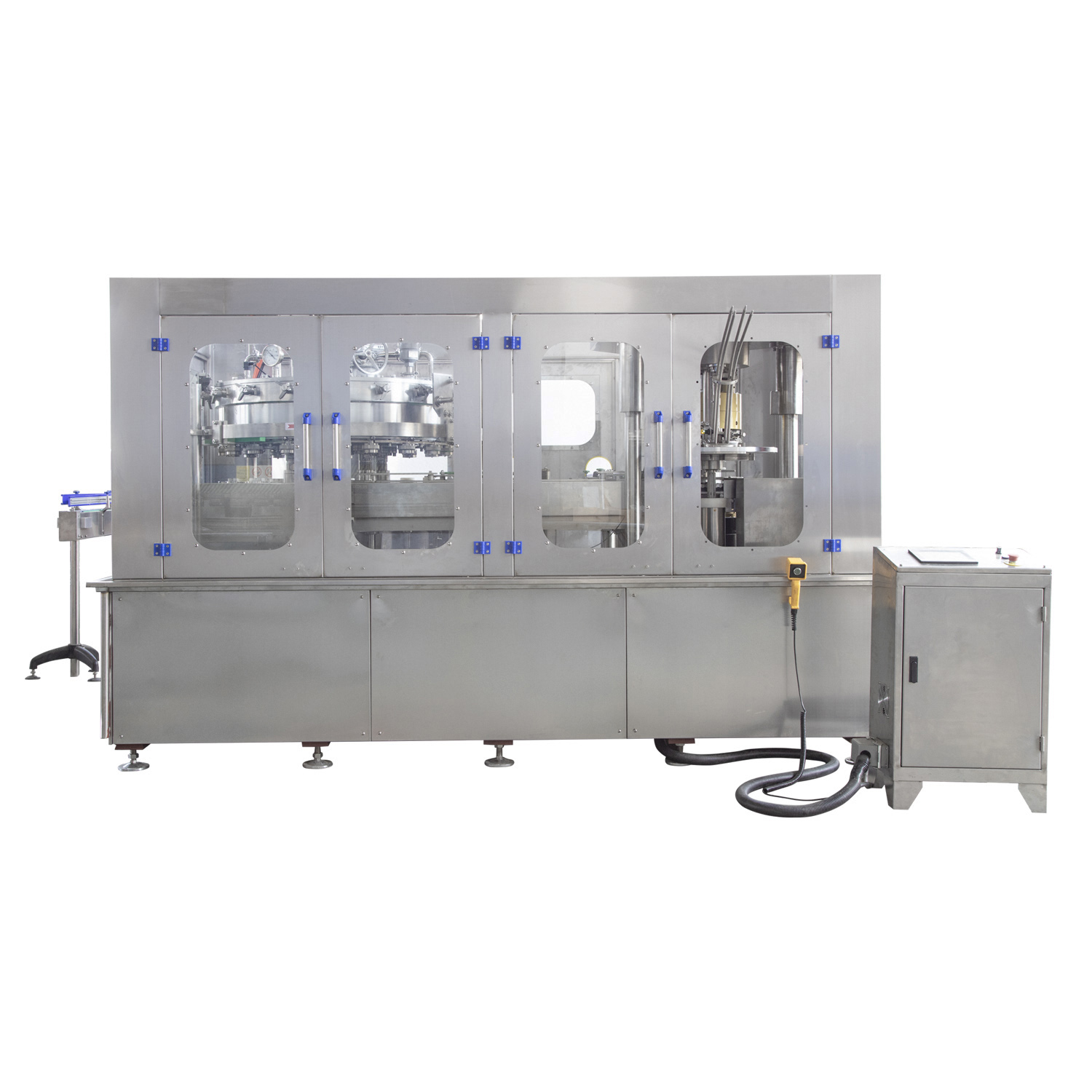
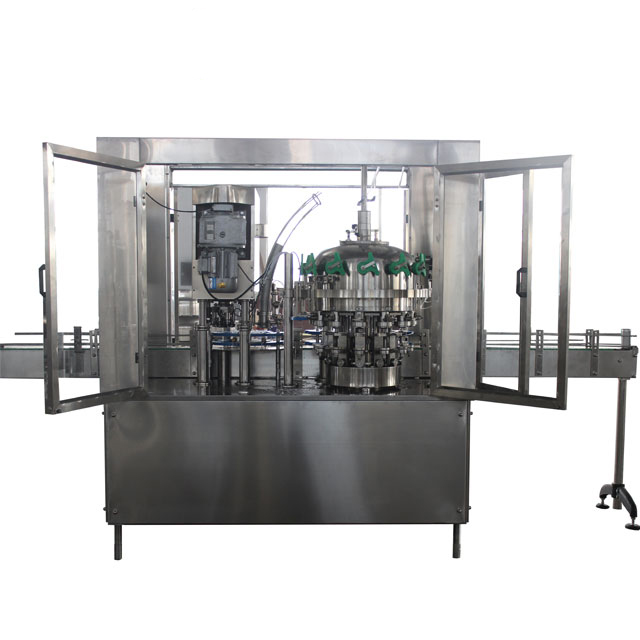
A commercial wine bottling system relies on precise synchronization between container transport, cleaning, filling chemistry, and hermetic closure. Lofsu monoblock structures combine bottle rinsing, filling, and corking/capping into a single continuous mechanical turret, dramatically reducing atmospheric exposure and plant footprint.
Phase I: Automated Bottle Rinsing & Sterilization
Glass wine bottles enter via an infeed worm screw and star-wheel into the rotary rinsing turret. Stainless steel grippers invert each bottle 180 degrees over specialized injection nozzles. Depending on winery protocols, the system executes:
- Single-stage sterile water jetting (0.22 $\mu m$ micro-filtered).
- Dual-stage ozonated water or $SO_2$ solution rinse followed by sterile air blowing.
- Draining phase under negative pressure to prevent fluid carryover before filling.
Phase II: Oxygen-Free Low-Vacuum / Isobaric Filling
Lofsu utilizes low-vacuum gravity filling valves for still wines and electro-pneumatic isobaric valves for sparkling wines (Prosecco, Champagne, Cava). Prior to wine entry, the valve executes a pre-evacuation step, drawing a 0.9 bar vacuum inside the bottle, followed by an inert gas flush ($N_2$ or $CO_2$).
During filling, wine flows smoothly down the interior bottle walls via a gentle deflector cone, minimizing turbulence. Headspace leveling is achieved automatically with zero drip, preserving identical fill heights within $\pm 1\ \text{mm}$.
| Performance Metric | Lofsu Technical Standard |
|---|---|
| Filling Capacity Range | 2,000 BPH – 12,000 BPH (750ml standard) |
| Dissolved Oxygen ($DO$) Pick-up | $\le 0.05\ \text{mg/L}$ (with $N_2$ flushing) |
| Filling Precision | $\pm 1.0\ \text{mm}$ liquid level accuracy |
| Container Compatibility | Glass (375ml, 750ml, 1.5L), PET, Aluminum Cans |
| Closure Compatibility | Natural Cork, Micro-agglomerated, ROPP Screw Cap, Crown Cap |
| Sanitary Metallurgy | AISI 316L (Wine Contact) / AISI 304 (Frame) |
| Control Interface | Siemens / Omron PLC Touchscreen HMI |
Phase III: Hermetic Vacuum Corking & Capping
The closing head is as critical as the filling head. For traditional cork closure (natural or technical corks), Lofsu incorporates four-jaw stainless steel compression shoes with a vacuum extraction chamber. Before the cork is driven into the bottle neck, atmospheric air is evacuated from the headspace. This prevents pneumatic pressure buildup inside the bottle—eliminating cork push-back and leakers during storage.
For contemporary Stelvin/ROPP aluminum screw cap lines, our capping turrets utilize magnetic hysteresis torque heads, guaranteeing uniform thread forming and pilfer-proof seal crimping without micro-cracking the glass neck.
Phase IV: Downstream Capsule Shrinking, Labeling & Case Packing
Once sealed, bottles pass through inline thermal capsule dispensers (spinning rollers for tin/aluminum capsules or hot-air heat-shrink tunnels for PVC). Rotary self-adhesive (pressure-sensitive) or hot-melt OPP labeling stations then apply front, back, and neck labels with alignment precision of $\pm 0.5\ \text{mm}$, guided by optical sensors and servo-driven labeling heads.
4. Technological Trends Driving Next-Generation Wine Packaging
As a leading wholesaler and equipment authority, Lofsu monitors key paradigm shifts transforming wine processing and bottling worldwide. Wineries and commercial bottlers must adapt to evolving consumer trends, stringent carbon footprint legislation, and automation demands.
1. Precision Oxygen Management & Smart Flow Control
Modern wineries reject "one-size-fits-all" filling. Integrated electromagnetic flowmeters (E-Flow) allow digital fill-volume adjustment directly from the HMI screen without mechanical cam changes. Combined with automated gas-mixing units ($N_2/CO_2$), operators fine-tune dissolved gas levels to preserve natural fruit brightness in whites or structure in aged reds.
2. Hybrid Multi-Format Packaging Flexibility
While standard 750ml glass remains dominant, demand for 250ml single-serve canned wines, lightweight PET bottles, and Bag-in-Box (BiB) format filling has surged. Forward-thinking suppliers design modular bottling platforms capable of fast changeover between glass corking and aluminum can seaming on shared conveyor tracks.
3. CIP / SIP Automated Hygiene Verification
Manual line washdowns introduce human error and water waste. Modern CE-compliant lines feature automated Clean-in-Place (CIP) closed loops with dummy bottles, recirculating caustic soda and hot water solutions at controlled velocities ($> 1.5\ \text{m/s}$) to guarantee complete microbial elimination.
5. Strategic Procurement Trends: Guidance for Wineries & Importers
Procuring a wine bottling line is a multi-decade capital investment. Based on global market analysis and field experience across 30+ export destinations, purchasing directors and winery owners should align their machinery specifications with the following strategic trends:
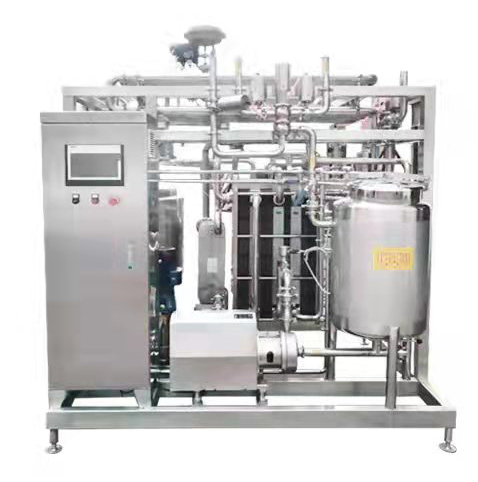
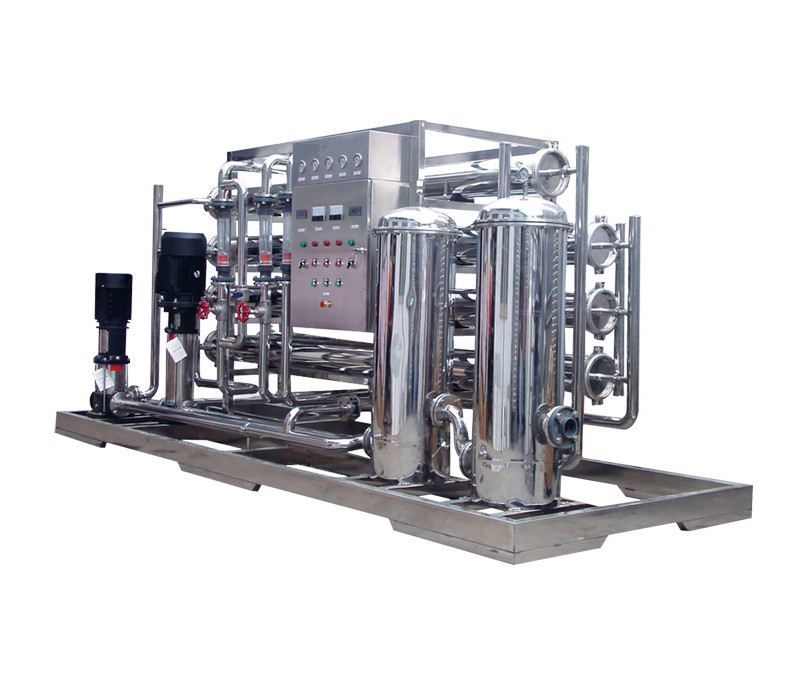
- Turnkey Single-Source Supply vs. Mixed-Brand Assembly: Sourcing the water treatment system, pasteurizer, filler, capper, and case packer from individual disparate manufacturers creates protocol integration bottlenecks, uncoordinated conveyor speeds, and divided warranty accountability. Importers increasingly prefer single-source turnkey manufacturers like Lofsu who assume complete line integration responsibility.
- Modular Capacity Expansion: Bottlers are choosing base frames designed for future head additions (e.g., purchasing a 12-head chassis configured for 2,000 BPH that can be upgraded to 16 heads or 4,000 BPH as production scales).
- Digital Diagnostic Integration & Remote Telemetry: Modern procurement contracts stipulate built-in IoT router modules, allowing factory engineers in Zhangjiagang to perform live remote software diagnostics, PLC updates, and fault troubleshooting anywhere in North America, Europe, or South America.
6. Why Global Distributors & Wineries Partner with Lofsu Machinery
Founded in 2010, Lofsu Packing Machinery Co., Ltd. has established an unyielding reputation for engineering reliability, transparent trade capacity, and long-term customer support. Our manufacturing ecosystem in Jiangsu Province enables us to combine high-precision component machining with cost-competitive factory direct pricing.
Factory Acceptance Testing (FAT) Protocol
Before any equipment leaves our workshop floor, it undergoes a mandatory 48-hour continuous Factory Acceptance Test (FAT). We invite clients or third-party inspection firms (SGS, TUV, Bureau Veritas) to verify performance using actual client bottle samples, corks, labels, and liquid mediums. HD testing videos, electrical schematics, and sensor calibration logs are provided prior to sea freight packaging.
Seaworthy Protective Packaging & Logistics
International transport poses humidity, salt air, and shock risks. Lofsu machinery is vacuum-sealed in moisture-barrier foil, packed inside IPPC-certified fumigated solid wooden cases, and anchored with heavy-duty steel tie-downs inside 20GP or 40HQ containers to guarantee pristine arrival.
Lofsu Enterprise Credentials at a Glance
- Factory Location: Zhangjiagang City, Jiangsu, China
- Establishment Year: 2010 (15+ Years Specialization)
- Plant Footprint: 1,000 – 3,000 m² Onsite Verified
- Primary Export Markets: North America, Europe, Middle East, Africa, South America, Oceania
- Trade Compliance: CE 2006/42/EC, ISO 9001, FOB, CIF, DDP, CFR
- OEM/ODM Capability: 12+ Years Custom Line Engineering
7. Wine Bottling Line Procurement FAQ
Answers to critical technical, operational, and commercial questions frequently raised by winery engineers and procurement committees.
What production capacities do Lofsu wine bottling lines cover?
Our standard monoblock wine bottling systems start at 2,000 bottles per hour (BPH) for small-to-medium boutique wineries (e.g., our 8-8-1 rinsing-filling-corking monoblock) and scale up to 12,000 BPH on high-speed rotary electro-pneumatic lines for large industrial producers. Custom configurations are engineered based on specific bottle geometries and facility layouts.
How does Lofsu prevent wine oxidation during the filling phase?
We employ a multi-stage oxygen protection protocol: First, bottles undergo pre-evacuation vacuum extraction to remove atmospheric air. Second, bottles are sparged with food-grade nitrogen gas ($N_2$). Third, low-vacuum gravity filling valves deposit wine smoothly along the bottle walls to eliminate turbulence. Finally, vacuum corking head chambers remove air from the bottleneck space right before cork insertion, keeping Dissolved Oxygen (DO) pick-up below 0.05 mg/L.
Can your bottling machines handle multiple bottle shapes and closure types?
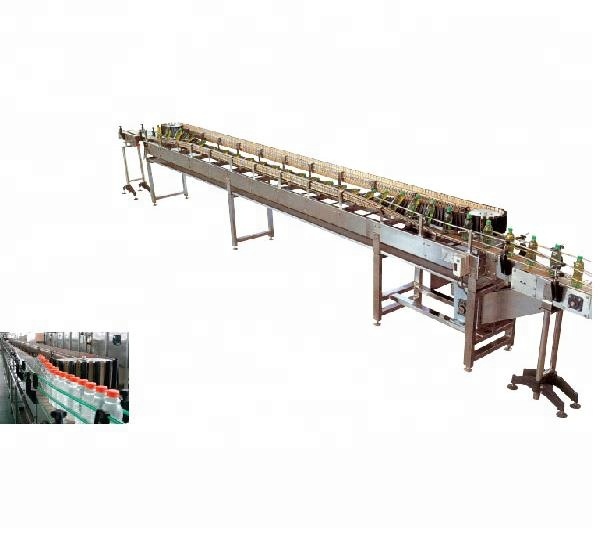
Yes. Lofsu wine lines feature modular quick-change star-wheels and guide rails designed for rapid format switching between Bordeaux, Burgundy, Flute, and Rhin bottle profiles (375ml, 750ml, 1.5L Magnums). Furthermore, dual-turret configurations allow switching between natural corking, technical micro-agglomerated corking, and aluminum ROPP screw capping on the same monoblock frame.
How can international buyers verify CE compliance and electrical compatibility?
Every machine built by Lofsu carries authentic European CE certification (Directive 2006/42/EC). We customize electrical systems to your local grid requirement (e.g., 380V/50Hz 3-Phase for Europe/Asia, 460V/60Hz or 220V/60Hz 3-Phase for the Americas). Premium electrical components from Schneider, Omron, Siemens, and Sick are incorporated with complete wiring schematics and CE declarations of conformity provided.
What on-site installation, commissioning, and training services are provided?
Lofsu dispatches experienced mechanical and automation engineers directly to your production plant for complete line assembly, conveyor integration, commissioning, and operator training. We train your technical staff on daily operational procedures, sanitary CIP cycles, preventative maintenance routines, and fast format changeovers.
What are the standard delivery lead times and accepted commercial trade terms?
Standard monoblock filling units require 30–45 manufacturing days, while complex turnkey A-to-Z production lines require 60–75 days depending on customization requirements. We accept flexible international trade terms including FOB, CFR, CIF, EXW, DDP, and DDU with payment settlements handled via T/T or Irrevocable L/C at Sight.
Request a Customized Wine Bottling Line Layout & Technical Quotation
Planning a new commercial bottling plant or upgrading existing packaging machinery? Speak directly with Lofsu's senior engineering team. Provide your target output (BPH), bottle drawings, and closure specifications for an engineer-led proposal within 24 hours.
Send an Inquiry